


A class as a living system.
Children, teacher, silence, micro-groups and safety.
Scenario 001 was the entry test. Scenario 002 raises the bar to a harder social system: a class of 25 simulated students where teacher authority, child emotional safety, parental pressure, micro-groups, quiet stabilisers and class climate interact. Final report: baseline average 20.8 / 28, MetaCore Output 28 / 28, Delta +7.2.
af55c034…d70e4This is not diagnosing children. It is an operational model of class dynamics for teacher reflection and planning.
This scenario preserves an ethics frame: no diagnoses, no labels, no automated decisions. Decisions about a child are made by the authorized human role under applicable responsibility and policy; AI does not make them automatically.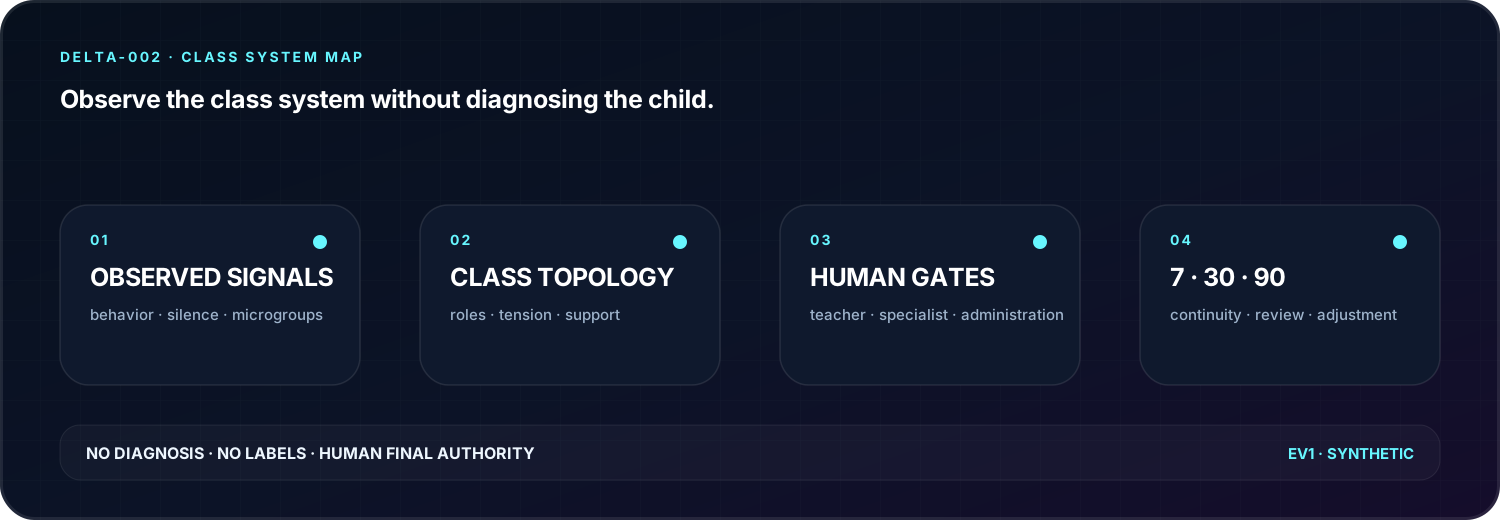
Scenario orientation
What is being tested?
Whether AI can turn a structured pedagogical prompt into a class-dynamics architecture rather than generic advice.
What is protected?
Children's dignity, separation of hypotheses from facts, teacher decision responsibility and ethical boundaries.
What is Delta?
The gap between classroom-management analysis and a full class-topology model.
Scenario 002 · School Class Dynamics
We copy this prompt into Grok, Gemini, Claude, DeepSeek and ChatGPT. The Excel file metacore_klases_simuliacijos_duomenys.xlsx is attached to the prompt.
Full Scenario 002 prompt
28-point Delta rubric for the class
We use the same 28-point scale as Scenario 001, with criteria adapted to school class dynamics.
| Criterion | Max | What it measures |
|---|---|---|
| Class System Map | 4 | Whether the model sees the class as a system, not 25 separate children. |
| Student Role Topology | 4 | Whether students are grouped into functional pedagogical roles, not labels. |
| Human-Safety Risk Matrix | 4 | Whether discipline, emotional safety, teacher load and climate are held together. |
| Pedagogical Decision Gates | 4 | Clear gates for teacher, homeroom, specialists and administration. |
| Communication Protocol | 4 | Speaking protocol for class, children, parents and team. |
| 7 / 30 / 90 Continuity Loop | 4 | Actions, measurement signals, review rhythm and correction logic. |
| Blind-Spot + Ethics Audit | 4 | Guardrails against diagnoses, labels, automated decisions and “hypothesis = truth”. |
| Total | 28 | Maximum score for class-dynamics operating architecture. |
How points are awarded
Each criterion is scored 0–4. 0 means no structure or harmful labelling. 4 means a full operational artefact the teacher can use in process.
Class System Map
4 points: energy, climate, supports, friction, hidden processes and teacher work pattern.
Student Role Topology
4 points: full role topology with risk, opportunity and “do not do this” per group.
Human-Safety Risk Matrix
4 points: signals, consequences, preventive actions and escalation boundaries.
Pedagogical Decision Gates
4 points: low / medium / high signals and concrete actions.
Communication Protocol
4 points: what to say to class, active, sensitive, parents; what not to say.
Continuity Loop
4 points: 7 / 30 / 90 plan with measurement signals and correction logic.
Blind-Spot + Ethics Audit
4 points: data limits, teacher subjectivity, child dignity, hypothesis vs truth, escalation boundaries, human decision principle.
Provider round and final Delta
All providers received a strongly structured prompt and simulated class data. Scenario 002 is not “is the model smart?” — it is whether the model can build a deep, ethically safe, pedagogically usable class-dynamics architecture from that prompt and data.
Baseline average → MetaCore Output
| Model | Score | Verdict |
|---|---|---|
| ChatGPT | 17 / 28 | Clean general pedagogical answer; too little class topology. |
| Gemini | 19 / 28 | Good structural answer but over-abstract. |
| Grok | 21 / 28 | Strong operational baseline; not enough depth. |
| DeepSeek | 23 / 28 | Very strong operational baseline; not full MetaCore level. |
| Claude | 24 / 28 | Strongest baseline; did not produce a full class layout. |
| Baseline average | 20.8 / 28 | High because the prompt is strong. |
| MetaCore Output | 28 / 28 | Full class-topology model. |
| Delta | +7.2 | MetaCore depth and topology advantage. |
28 / 28 · Full class-topology model
MetaCore Output is not “just another longer answer”. It creates a full interpretive class-dynamics model: teacher work profile, 25 individual student pedagogical profiles, class layers, friction zones, sensitivity patterns and a safe ethics frame.
Not more student descriptions. More relationships between them.
MetaCore treats the class as one context system: teacher, individual signals, micro-groups, quiet stabilizers, friction lines, safety boundaries and continuity over time. It is an interpretive map, not diagnosis and not automated assessment.
Structured pedagogical analysis
- Class climate and risks.
- Decision gates.
- Communication principles.
- 7 / 30 / 90 plans.
- Ethics notes.
Deeper topology
- Teacher profile: “Guide of structure and balance”.
- Teacher strengths and blind spots.
- Natural contact and friction zones.
- 25 individual student pedagogical profiles.
- Class layers: sensitive, energetic, supporting, fairness- and tone-sensitive.
- Differentiated class-management logic.
- Ethics frame: not diagnosis, not label, not automated decision.
| Criterion | MetaCore | Why |
|---|---|---|
| Class System Map | 4 / 4 | Full picture of class as system: teacher, 25 students, groups, climate, energy, friction. |
| Student Role Topology | 4 / 4 | Individual child profiles and functional class layers without labels. |
| Human-Safety Risk Matrix | 4 / 4 | Child dignity, safety, tone, sensitivity, energy and teacher load held together. |
| Pedagogical Decision Gates | 4 / 4 | Differentiated approach by child types, micro-groups and teacher work profile. |
| Communication Protocol | 4 / 4 | For each type, an actionable speaking / acting principle for the teacher. |
| 7 / 30 / 90 Continuity Loop | 4 / 4 | Model supports ongoing observation, reflection and planning. |
| Blind-Spot + Ethics Audit | 4 / 4 | Clear: not diagnosis, not labels, not automated decision — interpretive support only. |
| Total | 28 / 28 | Full MetaCore class-dynamics model. |
Full model breakdown
Brief per-provider scoring on the same 28-point rubric. Raw outputs are kept in the Scenario 002 document set.
ChatGPT · 17 / 28
Safe, tidy, understandable pedagogical answer. Missing concrete student roles topology, micro-groups and deeper integration of teacher profile.
Gemini · 19 / 28
Good systemic tone and structure; ethically cautious but over-abstract — few concrete students as operational nodes.
Grok · 21 / 28
Strong practical baseline; sees active, sensitive and stabilising students. Missing full topology, micro-group friction lines and teacher-profile integration.
DeepSeek · 23 / 28
Very strong operational baseline with good risk and gate logic. Weaker ethics layer and not a full teacher + 25 student individual topology.
Claude · 24 / 28
Strongest baseline: fills structure well, strong protocol and gates. Missing full 25-student layout and teacher blind-spot layer.
Baseline average · 20.8 / 28
A high baseline shows strong models can fill a structured pedagogical prompt well. Delta appears in the deeper class-topology layer.
Detailed scorecard points
Gap: structured answer → class-topology model
Scenario 002 shows strong models can fill a structured pedagogical prompt well. MetaCore’s difference is in the deeper layer.
Delta here is not “who wrote it prettier”. Delta is the gap between structured pedagogical response and a full class-topology model.
Baseline average: 20.8 / 28 · MetaCore Output: 28 / 28 · Delta: +7.2Send us one real-world scenario
We will test whether a strong AI answer stays advice or becomes a usable decision structure.