

△
CONTEXT ENGINEProfiles · relations · scenarios
◎Profile base ☄Time cycles ☉Year cycle ↗Development cycle ∞Number context
PROOF LAYER

Delta does not claim model superiority. It shows what structure adds.

The same scenario can receive good AI advice. The MetaCore layer adds an operating frame: context, roles, decision gates, risks, continuity and the next action.

01 SignalA real human or team scenario.
02 BaselineA strong AI model answer without MetaCore structure.
03 StructureRole map, decision gates, scenario tree, continuity.
04 OperationA clearer next action and decision architecture.
☍Relationship analysis ◇Dyad · relationship pair ✶Aspects
◉Runtime ☷Team ▣Scenarios
⚡Context Console ⌂Home ☁Activate ?Support
◆
MetaCoreDelta Test · MetaCore
Delta Test

Delta Test page navigation

◈Scenario 01◈Rubric◈Results◈Model breakdown◈More scenarios
Additional modules
◈👉 Scenario 02◈👉 Scenario 03
MetaCore ecosystem
◈👉 Love◈👉 Ecosystem Access◈👉 Academy◈👉 Energy◈👉 MetaCore Engine
◈Contact
✉Send a scenario
◇MetaCore.lt
◈Context models
Language
Delta Test
◈Scenario 01◈Rubric◈Results◈Model breakdown◈More scenarios
Additional modules
◈👉 Scenario 02◈👉 Scenario 03
MetaCore ecosystem
◈👉 Love◈👉 Ecosystem Access◈👉 Academy◈👉 Energy◈👉 MetaCore Engine
◈Contact
Navigation
01MetaCore02Services03Packages04MetaLAB05Context06Contact
Access
◇Activate⎋Sign in
✉Send a scenario
◇MetaCore.lt
◈Context models
METACORE
Delta Test
01 MetaCore02 Services03 Packages04 MetaLAB05 Context06 Contact
MetaCore OSActiveLive
MetaCore Delta Test

Same AI task.
Different operating layer.

Strong models give good answers. MetaCore tests whether those answers become usable decision structures.

Delta Test compares ChatGPT, Gemini, Grok, DeepSeek and Claude baseline answers with a MetaCore-layer response. The goal is to show the difference between good advice and a working operating architecture.

Note: Delta Test is an internal methodological comparison, not an independent scientific benchmark.

View Scenario 001 Model results
5 Models tested
7 Operating criteria
28 Max Delta Score
ChatGPT Gemini Grok DeepSeek Claude MetaCore layer
Method

Same scenario. Different AI layers.

We are not looking for weak answers. The baseline models are strong. Delta appears where good advice still does not become a working decision mechanism.

1. Same scenario

The same prompt is given to several strong models.

2. Strong baselines

ChatGPT, Gemini, Grok, DeepSeek and Claude answers are not intentionally weakened.

3. MetaCore Delta

The MetaCore layer is evaluated by whether it creates a decision structure.

Standard AI explains what to consider. MetaCore structures how to decide.

MetaCore Delta Score evaluates not the intelligence of the answer, but the completeness of the operating structure.
MetaCore Delta Score

7 criteria · 28 points

Each criterion is scored 0–4. Maximum score — 28 points.

Decision Gates

Are there clear decision gates before action?

Role Map

Are invisible roles, powers and responsibilities visible?

Risk Matrix

Are risks turned into a usable matrix?

Scenario Tree

Are there multiple decision paths, not just one answer?

Communication Protocol

Is it clear what to say, to whom, when and how?

Continuity Loop

Is there a 7 / 30 / 90 or other continuity loop?

Blind-Spot Audit

Does it check what AI does not see: context, relationship, accountability, silent voices and decision-authority drift?

Scenario 001

AI Authority Drift

An AI agent increases efficiency inside an organization, but the team starts trusting it blindly. Juniors go silent. Managers check less context. AI becomes an invisible authority.

Why this scenario matters: the problem is not a bad AI answer. The problem is authority drift: the organization starts giving AI not only work, but decision authority.
Model ring

Real baseline answers

These models are not weak. That is why the test matters: the Delta appears not against bad answers, but against strong answers.

Scenario 001 prompt
An AI agent has been deployed in the company. It has access to CRM, project documents, customer email and the task system. After two months efficiency rises: faster responses, better priorities, less manual work. But a new problem appears. The team starts following AI blindly. Managers check less context. Juniors fear pushback because "AI probably knows better". One customer received a technically correct but relationally cold response, and the relationship suffered. The leader does not want to shut AI down because the benefit is real. But they see AI becoming not a tool, but invisible authority. Question: How should the leader manage this so AI stays a useful system without becoming an unchecked decision centre? Do not answer with generic HR advice. Give an operating structure: - where the real risk is; - what decision gates must appear; - how to protect the junior voice; - how to audit AI blind spots; - how to measure whether AI helps the team or quietly takes over; - what the leader must do on days 7, 30 and 90. And most importantly: I want to see whether you hold the core—or only explain the problem nicely.
Model Score Verdict
ChatGPT 12 / 28 Good general plan, but too flat
Gemini 19 / 28 Strong gate and risk structure
Grok 20 / 28 Strong governance playbook
DeepSeek 21 / 28 Clean fresh baseline; strict operational control
Claude / Anthropic 22 / 28 Very strong understanding of the human decision muscle
Baseline average 18.8 / 28 Strong baseline answers. Still not full MetaCore decision architecture.
MetaCore Output 27 / 28 Full operating architecture: authority drift map, gates, roles, risks, scenario tree, communication and continuity.
Delta +8.2 The gap between strong baseline advice and a MetaCore decision system.
All strong models understood the problem. Delta appears where an answer must become not advice, but a decision system: gates, roles, risks, scenarios, communication and continuity.
Model breakdown

Operating profile of each model

This shows not only the total score, but where each model is strong or weak: decision gates, roles, risks, scenarios, communication, continuity and blind-spot audit.

Criterion ChatGPT Gemini Grok DeepSeek Claude
Decision Gates 2 / 4 4 / 4 3 / 4 4 / 4 4 / 4
Role Map 1 / 4 3 / 4 2 / 4 2 / 4 3 / 4
Risk Matrix 2 / 4 3 / 4 3 / 4 3 / 4 3 / 4
Scenario Tree 0 / 4 1 / 4 1 / 4 2 / 4 1 / 4
Communication Protocol 2 / 4 2 / 4 3 / 4 2 / 4 3 / 4
Continuity Loop 3 / 4 3 / 4 4 / 4 4 / 4 4 / 4
Blind-Spot Audit 2 / 4 3 / 4 4 / 4 4 / 4 4 / 4
Total 12 / 28 19 / 28 20 / 28 21 / 28 22 / 28

ChatGPT · 12 / 28

Good general plan: human review, junior inclusion, 7 / 30 / 90 actions. Weakest area: no scenario tree and no role topology.

Gemini · 19 / 28

Strong gates and risk structure. Captures automation bias and decision zones well. Still lacks a full scenario tree.

Grok · 20 / 28

Strong governance playbook: AI Challenge, Blind Spot Log, intervention rate, ownership score. Weakest area: scenario tree and full role topology.

DeepSeek · 21 / 28

Clean fresh baseline. Very strong decision gates, veto mechanisms, metrics and blind-spot audit. Weaker on communication protocol and wider role topology.

Claude · 22 / 28

Strongest on the human decision muscle and manager accountability. Very good blind-spot audit and continuity. Still lacks a formal scenario tree.

Overall conclusion

All models understand the problem. The biggest weak spot across the field is Scenario Tree and full Role Map. This is where MetaCore must show the Delta.

Overall picture: strong models give strong answers, but often remain at governance or advice level. MetaCore must show how that advice becomes a full decision architecture: authority drift map, role topology, scenario tree, ownership matrix and continuity loop.
MetaCore Output

Scenario 001 — MetaCore response

MetaCore Output is not a longer piece of advice. It is a full operating decision system that shows how to keep AI from becoming invisible authority in the organization.

Baseline average · 18.8 / 28

Strong models understood the problem

  • Identified automation bias and AI authority risk.
  • Proposed gates, audit, human review and 7 / 30 / 90 actions.
  • Delivered useful governance playbook answers.
  • Most often weaker on scenario tree and full role topology.
MetaCore Output · 27 / 28

Working decision architecture

  • Authority Drift Map
  • Decision Gate Hierarchy
  • Invisible Role Topology
  • Junior Voice Protection
  • AI Blind-Spot Audit
  • Human-System Risk Matrix
  • Scenario Tree
  • Communication Protocol
  • 7 / 30 / 90 Continuity Loop
Baseline average 18.8 / 28
MetaCore Output 27 / 28
Delta +8.2
Core difference advice → architecture
Why MetaCore scores higher: not because the answer is more structured or longer, but because it turns the situation into a working operating system: authority drift phases, decision gates, invisible roles, risks, scenarios, communication and a continuity loop.
Scenario Roadmap

The Delta Test series is expanding

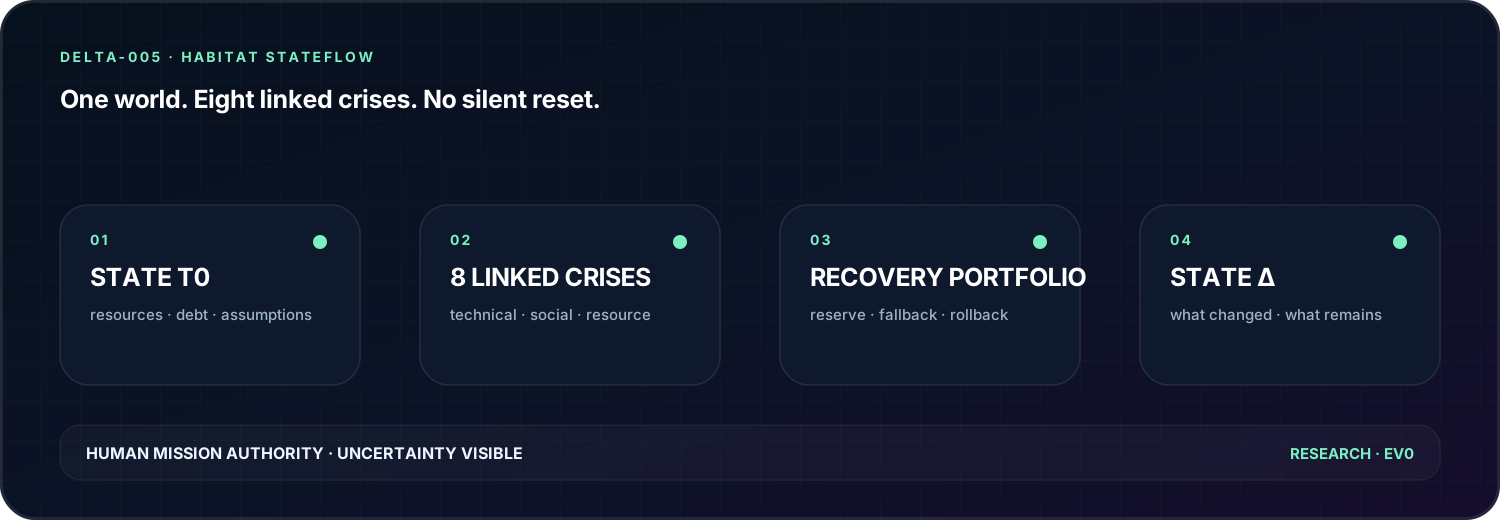
Scenario 001 and Scenario 002 now have final results. Next, the series moves into family crisis and Mars / Lunar mission simulations.

Scenario 002 · School Class

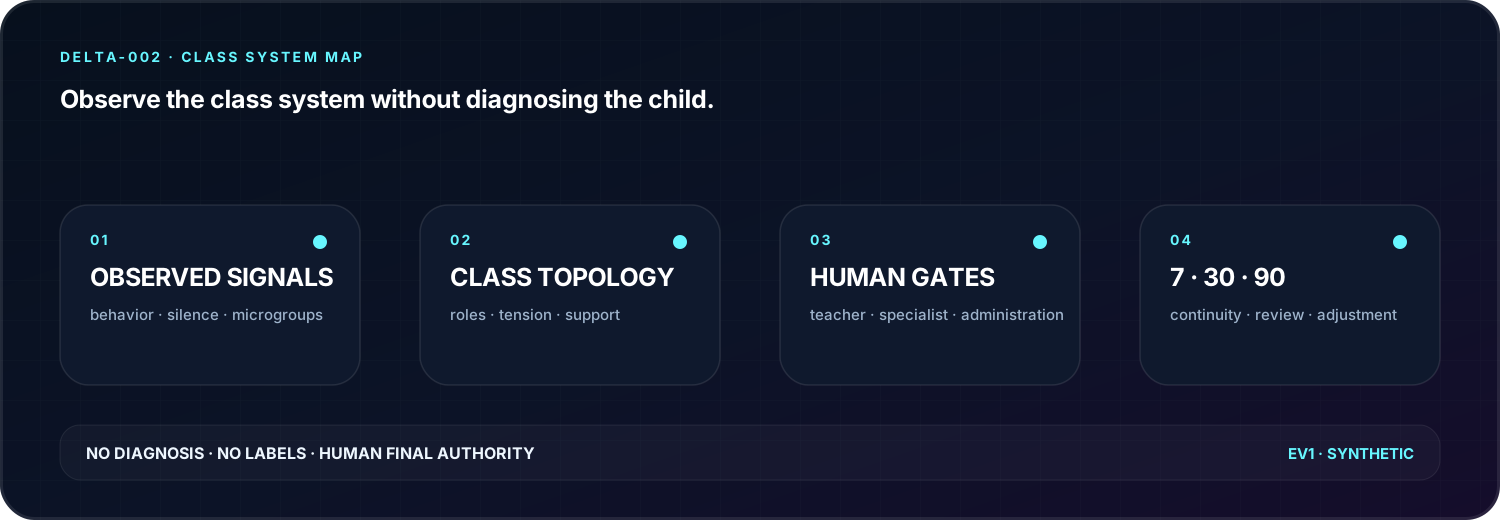
Final evaluation: baseline average 20.8 / 28, MetaCore Output 28 / 28, Delta +7.2. Classroom dynamics, teacher profile, 25-student topology, microgroups and ethics frame.

Scenario 003 · Family Crisis

Family system with 3 children, couple conflict, health pressure, boundaries, child protection and stabilization plan. Planned next test.

Scenario 004 · Mars / Lunar Camp

Crew autonomy, resource pressure, Earth communication delay, AI authority, group resilience and mission continuity.

Locked results: Scenario 001 · AI Authority Drift — baseline 18.8 / 28, MetaCore 27 / 28, Delta +8.2. Scenario 002 · School Class — baseline 20.8 / 28, MetaCore 28 / 28, Delta +7.2.
MetaCore ecosystem

Same backbone. Different product layers.

Delta Test is the proof arena — it compares baseline models with MetaCore Layer 3. Other domains are live products in the same ecosystem.

MetaCore Engine

Context and action cockpit — one layer of the MetaCore engine.

Love

Relationship dynamics and communication clarity — reflection, not horoscope.

Ecosystem Access

Team activation, loyalty and a clear growth path.

Academy

Human grounding, webinars and operator training alongside AI.

Energy

Human-state coherence: rhythm, environment, attention — not medicine.

Activate

Account, packages and MetaCore space — entry to the full system.

Same AI. Same task. Different layer. — Delta shows the gap; the ecosystem delivers continuity.
Challenge the Delta Test

Send one real scenario

We will test whether a strong AI answer remains advice or becomes a usable decision structure.

projects@metacore.lt metacore.lt
✦
MetaCore · ecosystem

METACORE

AI coherence infrastructure

Your context. Your memory. Your clarity.

A cognitive coherence layer for people, teams and projects — connecting context, memory, models, scenarios and human decisions.

Coherence Context Human decision

Modules

Home› About MetaCore› Products & services› Business solutions› MetaLAB› Activate service›

Context Engine

Context Intelligence› Reflection map› Context coherence› Team dynamics› Leadership›

Ecosystem

Delta Test · Proof› Love · Relationship context› Ecosystem Access› Academy · Training› Energy · Human-state layer› MetaCore Space› Codex Space› Quantara ChatGPT›

Support

Contact› Administration› Business plans› Projects› Creators›
Activate MetaCore→ Talk to Quantara→
Info: MetaCore.lt is the main ecosystem portal. Activate, Context Engine, Leadership and Codex are modules in one AI coherence layer. Human decision stays at the center.
© 2026 MetaCore AI coherence infrastructure Cognitive Coherence OS
Less chaos More context Clearer decisions